







How to Find the Right Family Court Attorney
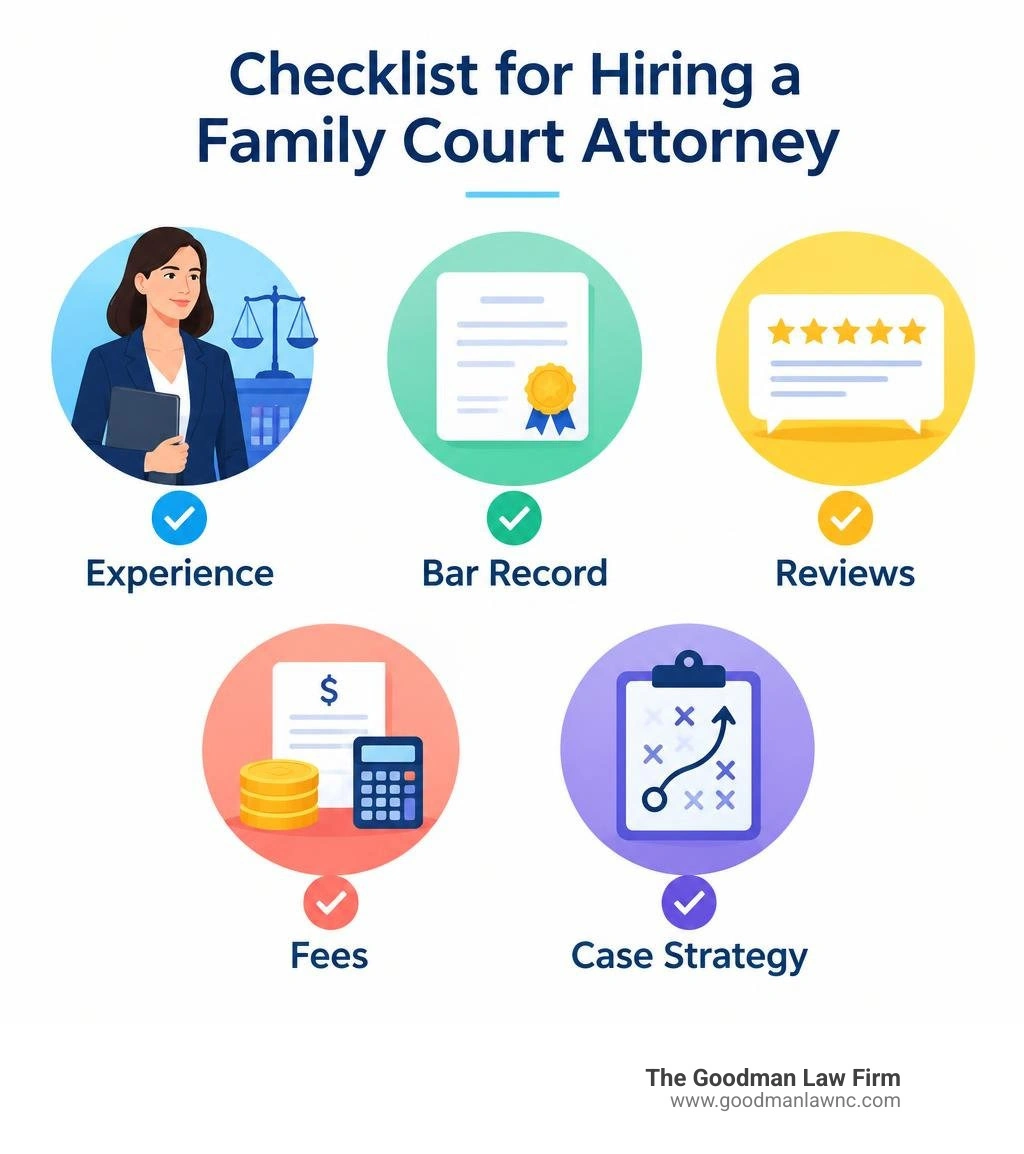
Choose a family court attorney who handles cases like yours, practices in your area, and explains both the likely costs and the possible paths forward. Before hiring, check their standing with the state bar, read reviews for specific details about communication, and ask who will handle your case day to day. The right fit should help you make clear decisions about your children, finances, and next steps without promising a result.
I'm Kara Goodman, founder and managing attorney of The Goodman Law Firm in Charlotte, North Carolina. My work as a family court attorney includes divorce, custody, support, and mediation, and I'll use that experience to help you know what to ask before you hire counsel.
What Does a Family Court Attorney Do?

Navigating domestic legal disputes can feel overwhelming, whether you are managing an unexpected separation or restructuring parental responsibilities. A family court attorney serves as your strategic advisor, negotiator, and courtroom advocate. Our job is to protect your parental rights, secure your financial stability, and guide you through local court procedures with clarity and empathy.
When domestic disputes arise, having dedicated counsel ensures your interests are safeguarded at every phase. Learning how an attorney assists during divorce proceedings clarifies how legal advocacy transforms an otherwise stressful process into an organized, step-by-step resolution. From drafting separation agreements to litigating complex matters before a judge, our comprehensive family law attorney services cover every facet of domestic relations.
Core Practice Areas in Domestic Relations
Family law spans far more than just dissolving a marriage. It addresses nearly every legal matter impacting domestic partnerships, children, and personal assets:
- Contested and Uncontested Divorce: Dissolving marital bonds while addressing equitable distribution of marital property and debt.
- Child Custody and Visitation: Formulating legal custody (decision-making authority) and physical custody (parenting schedules) that serve the best interests of your children.
- Child Support and Spousal Support: Calculating fair financial support based on statutory guidelines, income, earning capacity, and marital standard of living.
- Paternity Establishment: Legally identifying a child’s biological father to secure parental rights, visitation, and financial obligations.
- Stepparent and Relative Adoptions: Guiding families through background clearances, consent requirements, and termination of parental rights when formalizing new family structures.
- Domestic Violence Protective Orders: Seeking emergency legal protections or defending against domestic claims.
- Post-Decree Modifications: Petitioning the court to modify existing custody or support orders when a substantial change in circumstances occurs.
Understanding how these areas intersect is essential. Exploring the foundational understanding of family law framework helps clients see how state laws shape their rights. Many people also wonder about specific roles within the legal profession; reviewing the differences between a family lawyer and a divorce lawyer helps you decide on the right scope of representation for your household.
Dispute Resolution Paths: Mediation, Collaborative Law, and Litigation
Every domestic case does not need to turn into an exhausting courtroom battle. In fact, most family law matters are resolved outside the courtroom through alternative dispute resolution (ADR). Choosing the right dispute path depends on your goals, the level of conflict between parties, and the complexity of your marital estate.

| Resolution Method | How It Works | Key Benefits | Best Suited For |
|---|---|---|---|
| Mediation | A neutral third party facilitates structured settlement discussions between both spouses and their attorneys. | Cost-effective, confidential, private, and keeps decision-making power in your hands. | Amicable to moderately contentious disputes where both parties want to avoid trial. |
| Collaborative Law | Both parties and their separately retained collaborative attorneys sign a contract committing to settle without court intervention. | Encourages transparent problem-solving; uses neutral financial and child specialists. | Couples committed to mutual transparency, open communication, and preserving co-parenting relationships. |
| Courtroom Litigation | Formal legal proceedings where evidence and testimony are presented to a family court judge who makes binding rulings. | Finality through enforceable judicial orders; full discovery procedures to uncover hidden assets. | High-conflict cases, domestic abuse, hidden assets, or where one party refuses to negotiate fairly. |
How to Evaluate Legal Credentials and Experience

Hiring the right legal counsel is one of the most critical decisions you will make during a domestic dispute. Because family law outcomes affect your children and finances for years to come, choosing an attorney requires careful evaluation rather than picking the first name you see online.
Knowing how to choose the right family law attorney gives you the framework to screen potential advocates effectively. You can also explore directories such as the Best Family Lawyers on Justia to compare backgrounds, peer reviews, and practice philosophies.
How to Evaluate the Background of a Family Court Attorney
When assessing potential legal counsel, look closely at their core practice focus and local familiarity:
- Dedicated Practice Focus: Family law evolves continuously. An attorney who devotes their practice specifically to domestic relations will understand nuanced local rules and procedural tactics far better than a general practitioner handling real estate or traffic tickets.
- Local Courtroom and Judicial Familiarity: Every county court maintains distinct administrative rules, local forms, and judicial preferences. Working with a practitioner experienced in Mecklenburg County ensures your filings comply with local scheduling requirements and domestic court rules.
- Trial Readiness and Negotiation Skill: While peaceful settlement is generally the goal, your advocate must possess trial experience. An attorney who is confident in the courtroom can negotiate from a position of strength during mediation.
If you are seeking an experienced family lawyer near me or searching for the best family law attorney in Charlotte, NC, look for someone who balances courtroom capability with a genuine commitment to compassionate advocacy.
Verifying State Bar Disciplinary History and Client Testimonials
Never hire an attorney without verifying their professional standing. State regulatory bodies maintain searchable online directories where you can verify licensure status and check for past public disciplinary actions or ethical reprimands.
In addition to regulatory checks, analyze client reviews and peer ratings with a critical eye:
- Look for Substance Over Fluff: Genuine testimonials describe specific qualities—such as responsiveness during a crisis, clear financial explanations, or strategic settlement negotiations—rather than generic praise.
- Pay Attention to Turnaround and Efficiency: A strong indicator of quality counsel is their ability to move a stalled matter forward. In complex domestic matters, switching to dedicated, organized counsel can resolve cases in months that had previously languished for over a year under unorganized representation.
- Beware of Unrealistic Guarantees: Steer clear of any practitioner who guarantees exact outcomes or promises a complete victory. Ethical attorneys provide honest risk assessments rather than making promises they cannot keep.
Navigating Legal Fees, Retainers, and Case Costs
Understanding how domestic legal representation is billed helps avoid surprises and allows you to plan your budget. Transparent firms walk you through their fee schedule from the very first meeting, providing clear expectations for each phase of your case.
Finding affordable family law services is not about finding the lowest hourly rate—it is about finding an efficient, experienced advocate who avoids unnecessary busywork and works toward cost-effective resolutions.
Understanding Retainer Agreements and Billing Structures
Most family law matters operate on an hourly billing model supported by an initial retainer:
- The Retainer Deposit: A retainer is an upfront deposit placed into a dedicated client trust account. As your legal team works on your matter, billable time and case-related expenses are deducted from these funds according to the terms of your representation agreement.
- Hourly Increments: Work is typically billed in standard increments (such as tenths of an hour). This includes drafting pleadings, court appearances, legal research, phone calls, and email correspondence.
- Unearned Retainer Refunds: Any portion of your initial retainer deposit that remains unearned at the conclusion of your legal representation is returned to you.
- Itemized Billing Statements: Your firm should provide regular, itemized statements detailing the specific tasks performed, the time spent, and your remaining trust balance.
Additional Litigation Expenses and Fee-Shifting Rules
Beyond attorney hourly fees, litigation involves administrative and third-party expenses. These may include:
- Court filing fees and service of process costs
- Deposition transcripts and court reporter fees
- Neutral financial professionals, forensic accountants, or real estate appraisers
- Child custody evaluators or guardian ad litem fees
Can Your Ex-Spouse Be Ordered to Pay Your Fees?Clients frequently ask whether the court can order an opposing party to pay their legal expenses. While the general rule requires each party to bear their own legal costs, state family statutes permit judicial fee-shifting under narrow, specific circumstances—such as child support enforcement, custody actions involving an interested party acting in good faith without sufficient means, or dependent spouses demonstrating financial need in alimony claims. Your attorney will evaluate whether your circumstances qualify for a fee-shifting claim.
Preparing for Your Initial Legal Consultation
Your initial legal consultation is an opportunity to evaluate whether an attorney’s communication style, legal philosophy, and strategic approach align with your personal goals. Being prepared ensures you make the most of your time and walk away with actionable insights.
Reviewing what documents to bring to an initial family law consultation and gathering the essential items for a divorce consultation allows your lawyer to assess the strengths and challenges of your case right from the start.
Essential Questions to Ask a Family Court Attorney During a Consultation
To evaluate prospective counsel, ask direct, targeted questions during your initial meeting:
- How much of your practice is dedicated exclusively to family law and domestic relations?
- What is your strategic assessment of my situation, and what are the possible paths forward?
- Who in your office will be handling my day-to-day communications and drafting my documents?
- How do you approach alternative dispute resolution like mediation versus courtroom litigation?
- What are the estimated costs, retainer requirements, and billing practices for a case of this complexity?
- What immediate steps should I take—or avoid taking—to protect my parental rights and financial interests right now?
Organizing Evidence and Financial Disclosures
Providing organized documentation enables your legal team to build a strong foundation for your case immediately. Aim to assemble:
- Income and Tax Records: Recent federal and state tax returns (last 2–3 years), W-2s, 1099s, and recent pay stubs.
- Banking and Investment Statements: Statements for all checking, savings, retirement (401k, IRA), brokerage, and cryptocurrency accounts.
- Real Estate and Debt Documents: Mortgage statements, property deeds, auto loans, credit card statements, and loan applications.
- Existing Legal and Marital Documents: Prenuptial, postnuptial, or prior separation agreements, as well as any existing court orders.
- Parenting Records: School calendars, medical records, and a timeline of primary caregiving responsibilities.
Frequently Asked Questions About Family Law Representation
Can my spouse and I share the same attorney during a divorce?
No. Under legal ethics rules and professional conduct standards, a single attorney cannot represent both opposing spouses in a divorce proceeding. Even in the most friendly, uncontested separation, your legal interests are inherently distinct regarding property division, support obligations, and parental rights.
Dual representation creates an impermissible conflict of interest. However, spouses can jointly retain a single attorney to serve strictly as a neutral mediator. When serving as a mediator, the attorney does not represent either party or provide individual legal advice, but rather facilitates a mutual settlement agreement that each spouse can review with independent counsel.
Do I need legal counsel if my spouse and I agree on everything?
Even when you and your partner agree on all primary terms, working with an attorney is vital. Informal agreements or handwritten promises are rarely legally enforceable and can leave critical rights unprotected.
An attorney drafts comprehensive separation agreements and consent orders that comply with state statutory requirements, ensuring that terms regarding property distribution, tax liabilities, and custody cannot be easily challenged later. Exploring resources on determining whether you need an attorney and assessing the value of needing legal counsel when spouses agree on terms will help protect your future agreements against unforeseen legal pitfalls.
What should I expect from the child custody and divorce process timeline?
Every family legal timeline varies based on case complexity and court scheduling:
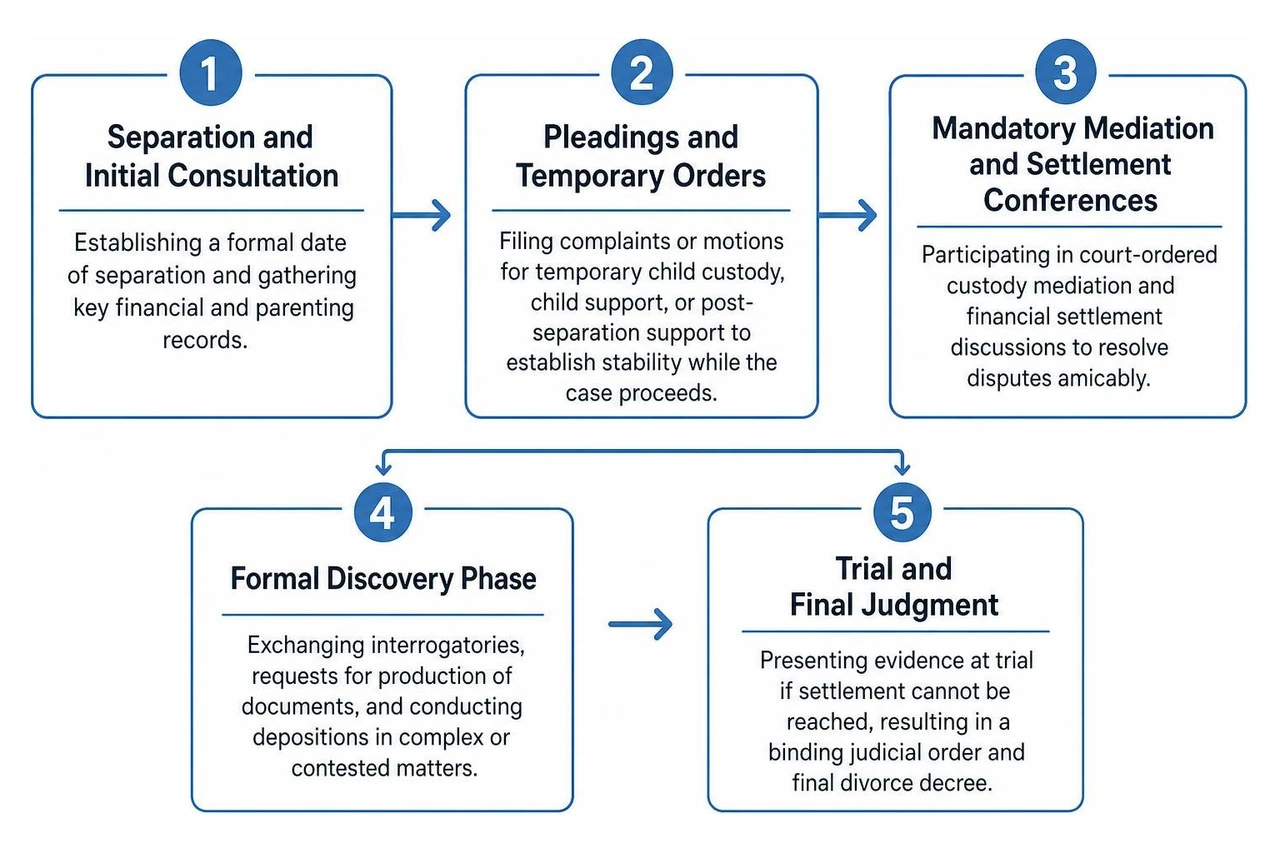
- Separation and Initial Consultation: Establishing a formal date of separation and gathering key financial and parenting records.
- Pleadings and Temporary Orders: Filing complaints or motions for temporary child custody, child support, or post-separation support to establish stability while the case proceeds.
- Mandatory Mediation and Settlement Conferences: Participating in court-ordered custody mediation and financial settlement discussions to resolve disputes amicably.
- Formal Discovery Phase: Exchanging interrogatories, requests for production of documents, and conducting depositions in complex or contested matters.
- Trial and Final Judgment: Presenting evidence at trial if settlement cannot be reached, resulting in a binding judicial order and final divorce decree.
Conclusion
Facing domestic legal disputes can be one of life's most challenging transitions, but you do not have to navigate it alone. Choosing the right legal partner provides clarity, protects your hard-earned assets, and secures a stable foundation for your children.
At The Goodman Law Firm, we combine over 15 years of dedicated family law experience with an empathetic, client-centered approach. Whether through strategic mediation or firm courtroom advocacy, our team is committed to guiding you forward with confidence. Reach out today for dedicated divorce and family law guidance tailored to your family's future.
We’re Here When You Need Us
Family law challenges can feel overwhelming, but you don’t have to face them alone. Let’s talk. Reach out today, and let’s take the next step together.